Just a review of how charter schools in North Carolina operate:



Looking at who sponsored the bill, there are no surprises.

Here is one of the primary sponsors, John Torbett, speaking at a Moms For Liberty gathering.

He also chairs this committee to “reinvent what public schools are in NC.”

Another chair on that committee is Hugh Blackwell, who happens to be a sponsor on said bill. Two other sponsors are Jeff Zenger and Tricia Cotham. They have aligned themselves with Moms For Liberty as well.

Cotham’s recent political activities have been quite public. Zenger’s maybe not as much, but as he is a local person in my district, it might be interesting if you knew this:


Lewisville, NC has less than 15K people.
Look at that last line in the quote above – “The real losers in this are the people of Lewisville who will be out $2 million from the general fund that could have been spent for a public use.”
Like traditional public schools that are accountable to local people?
John Bradford’s name as a primary sponsor is not surprising either. He has some history with catering with the charter school industry. From a post on this blog published in April of 2017:
As reported by Billy Ball on April 24th on NC Policy Watch in an article entitled, “House panel OKs charter school growth bill, corporate “perks” for charter partners (http://pulse.ncpolicywatch.org/2017/04/24/house-panel-oks-charter-school-growth-bill-corporate-perks-charter-partners/#sthash.CiIsfYLY.qgOZXEvz.dpuf),
A divided House Education Committee gave their approval Monday to a pair of controversial charter school bills, one of which will allow charters to expand student enrollment by up to 30 percent with no additional state review of their performance and finances.
The second proposal, House Bill 800, led by Rep. John Bradford, R-Mecklenburg, would speed “perks” for private charter school partners by providing their children enrollment priority for up to half of the school’s population, a provision that critics likened to making public charters into “de facto, segregated private schools.”
That second bill, HB800, was actually called a “jobs’ bill” by Bradford, who according to his website electbradford.com/meet-john/, is
“the President & Founder of Park Avenue Properties, a Cornelius based residential property management and real estate investment firm with operations in five states and eight cities.”
What many people may not know is that a charter school may already reserve up to fifteen percent of its enrollment for children of teachers, employees, and board members.
That’s right. Charter schools have private board members. Public schools do not.
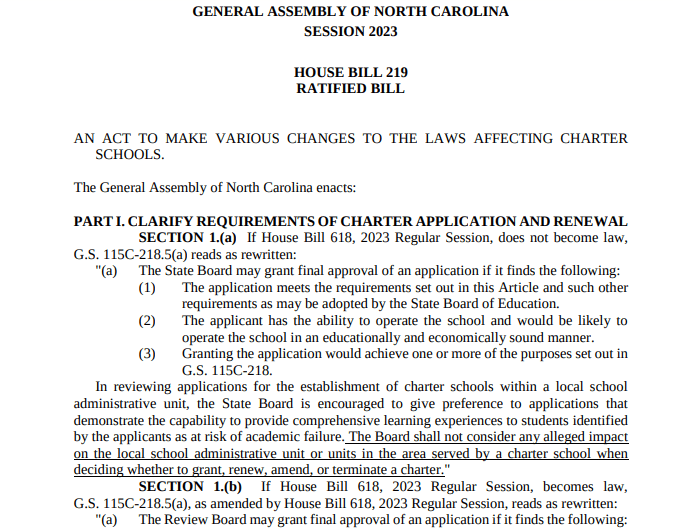
Here is a copy of the bill voted on yesterday in the North Carolina House.
And they won’t even put a school construction funding proposal on a state ballot.

 caffeinated rage